

BY MICHAEL BUKCHIN
Alango Technologies
WITH ALEXANDER GOLDIN & SUHAIL HABIB ALLAH
Alango Technologies
Hearing loss in older people often occurs together with various other health conditions. Cognitive decline can make it difficult to understand speech and follow conversations; visual impairment can make it difficult to operate hearing aids, read instructions, or recognize visual warnings on devices; dexterity problems can make it hard to manage small hearing aids.
It is important to consider all these variables in the design and development of simple and user-friendly assistive listening devices (ALDs).
There is now a range of technological, functional, and design solutions for these problems, which can be implemented in ALDs without compromising affordability and ease of use. The BeHear SMARTO assistive listening device from Alango Technologies has been specially developed to meet the expectations of this target group. The device is designed to be easy for the user to fit and easy to use, whilst also providing customized solutions for specific listening situations.
The first goal for a successful ALD outcome is to ensure the fitting is intuitive yet effective and optimised for the target hearing loss. The fitting strategy must maximise speech intelligibility and at the same time ensure the user does not perceive the amplified speech as uncomfortably loud. All speech frequencies should be amplified together so that a normal loudness boost is achieved for the overall speech spectrum but not for the individual frequency bands. At the same time, the fitting rationale should provide lower gain for frequency bands with more severe hearing loss and higher gain for bands with less severe hearing loss. This ensures that both audibility and speech intelligibility are optimised.
BeHear SMARTO allows the users to fit the device themselves, using one of three approaches.
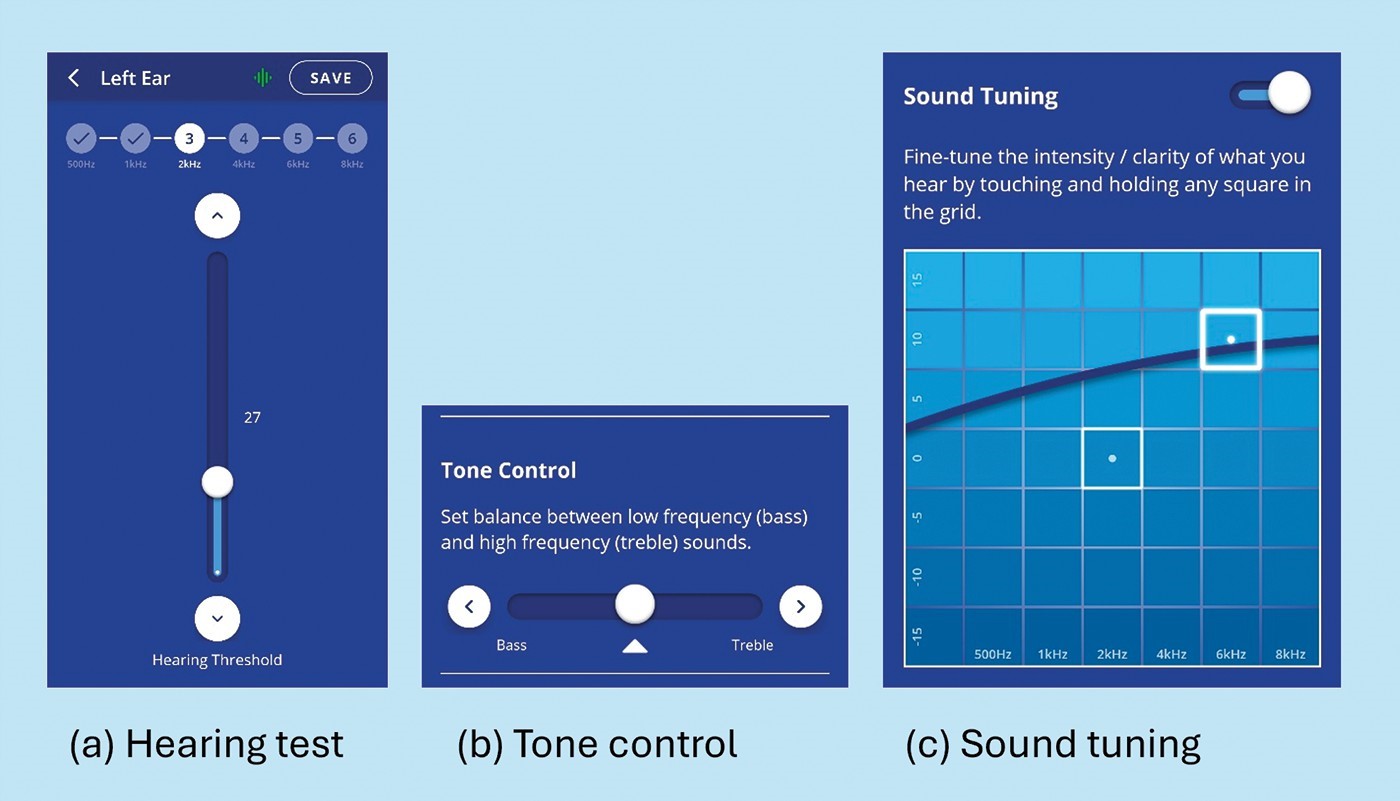
They may choose to do an in-situ hearing test (‘hearing threshold’) or simply adjust bass and treble controls (‘tone method’) or fine-tune the gain across different frequencies (‘sound tuning’) ( Figure 1). The BeHear app allows people with dexterity problems and visual impairments to do their own hearing test by moving or tapping large controls on the screen or using the phone’s volume buttons to find hearing threshold levels (Figure 1a). The software automatically calculates the gain and output, using the fitting rationale described above. This assessment can be repeated as many times as necessary to monitor the user’s hearing and for health tracking purposes.
Altneratively, the user can simply press the bass and treble buttons on the screen to optimise the hearing profile. In the background, the device will recalcuate the initial settings that were set by the audiogram (Figure 1b).
Finally, the user can manually fine-tune the fitting for loudness or clarity by sliding their finger over the grid on the screen, which will adjust the output in individual frequency bands (Figure 1c).
Directionality
Speech intelligibility is significantly impaired when hearing aids are used in noisy environments. Directional microphones are generally considered the best solution for hearing in noise because they can focus on sounds from one direction and reduce sounds
from other directions. The BeHear SoundFocus technology uses signals picked up by a pair of microphones on the front of the device. Users can steer the BeHear SMARTO in the desired direction when SoundFocus is activated.
Hearing Fast Talkers
Hearing loss impairs a person’s ability to hear individual phonemes, which means the brain needs more time to determine what is being said based on the overall context. Speaking quickly
during phone conversations presents an additional difficulty as there are no facial cues to help with comprehension.
BeHear SMARTO integrates a technology called EasyListen, which supports three levels of stretching, allowing users to choose the optimal speed of incoming speech during phone calls
Making and receiving phone calls directly from an ALD without having to pick up the phone is particularly helpful for people with hearing loss and limited dexterity. The BeHear SMARTO device is Bluetooth-enabled and works like a normal wireless headset, offering mobility and the convenience of voice communication and audio playback.
People with reduced mobility and complex health problems often need to dial an emergency number to ensure their safety and independence. With Bluetooth connectivity to a smartphone, BeHear SMARTO allows users to dial a predefined emergency number quickly and easily using a special emergency call button that is intuitively recognisable and easy to press. The user or their caregiver can pre-configure an emergency contact such as a family member or local emergency service via the BeHear app.
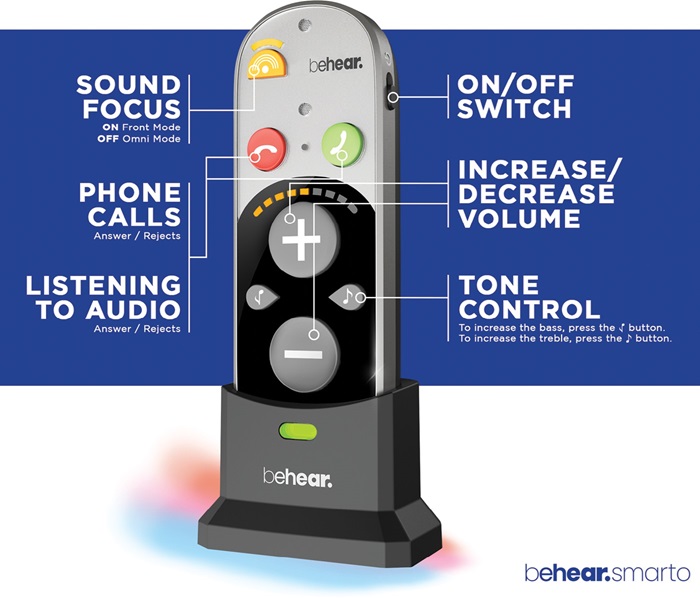
When developing user-friendly ALDs for older people, the focus is on simplicity and intuitiveness. By reducing the number of buttons and controls to essentials, the number of steps required to operate the device is minimised. Large, colored, clearly marked buttons are easy to find, understand and press. Different button shapes and profiles facilitate tactile recognition for people with impaired vision
Accidental button presses can impair device functionality, especially for users with limited dexterity or cognitive decline. To prevent this, the control buttons can be functionally disabled (locked) after the optimal settings for a particular user have been set. Selective locks can be applied to retain important functions such as emergency calls while deactivating others. The buttons can be locked together or individually in multiple function groups via the BeHear
app
For older adults with complex needs, a charging cradle is preferred over charging cables. Users can place the device in the magnetically guided stand easily, avoiding the difficulty of aligning and inserting small connectors
The BeHear SMARTO charging stand also features an asymmetrical design for confident rather than ambiguous insertion.
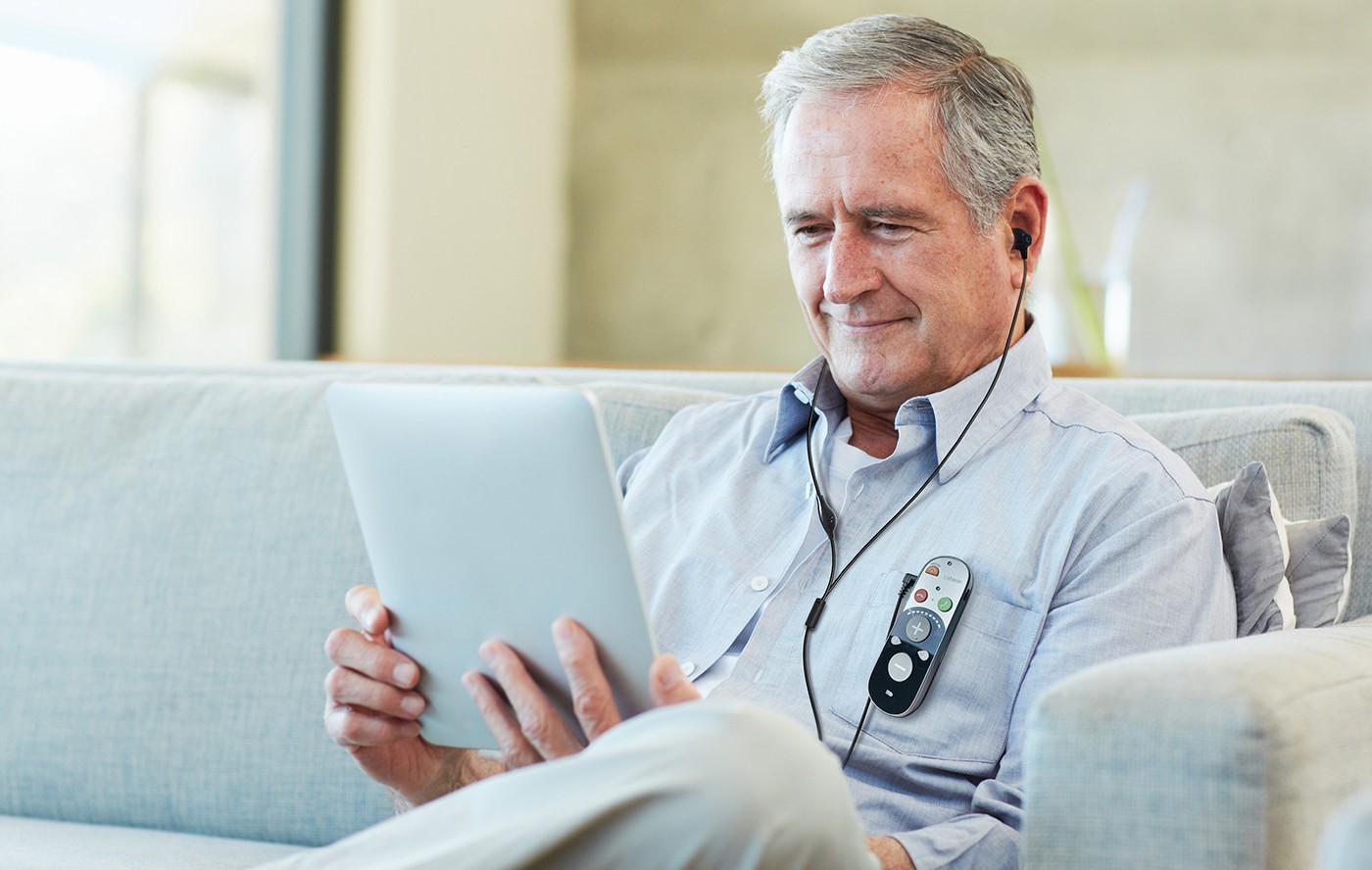
When developing assistive listening devices for people with severe hearing loss, limited mobility and complex health problems, there are various considerations beyond the amplification itself. The BeHear SMARTO hearing amplifier from Alango Technologies demonstrates how advanced features and thoughtful design can provide a multifunctional, user-friendly amplification device for older people. By addressing the interplay between hearing loss and other health conditions common in older people, BeHear SMARTO offers a comprehensive solution that improves quality of life for its users. It is distributed in Australia and New Zealand by xenonOz and is available on the HSP Fully Subsidised Device Schedule in the alternative listening device category.